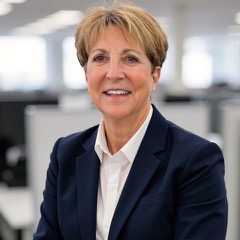
Candace Gantt is the executive director and founder of the Mind Your Brain Foundation, a national nonprofit built around an annual free conference for traumatic brain injury survivors, their families, and their caregivers. She is also a TBI survivor herself. In 2005, two weeks after completing her first half Ironman competition, she was struck by a construction vehicle while cycling and launched into a telephone pole. She spent ten days in a coma at Penn Medicine under the care of neurosurgeon Dr. Sean Grady, lost a month of memory on either side of the accident, and began the long process of relearning to walk, talk, and find her way back to a life she could barely remember.
What she built from that experience is one of the most important community infrastructure projects in the TBI world. And the conversation we had about it clarified something I've been circling around since I started this series: that recovery from brain injury is not primarily a clinical problem. It is a social one. And the systems we have built are not remotely designed for it.
Waking Up
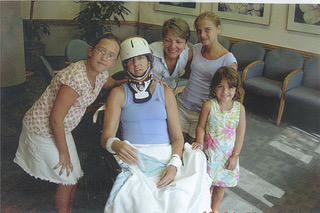
The first thing Candace described was not the accident. It was the shock of consciousness returning. She had no memory of the month before her injury or the month and a half that followed it. When she finally became fully aware of where she was, she was in a zipper bed at a rehabilitation center, wearing a helmet over the place where her skull plate had been removed, unable to escape, unable to understand most of what was being said to her. She had no idea what had happened.
"It was like opening my eyes for the first time and not recognizing where I was. It was terrifying. Like a caged animal. I needed to know what happened. Why am I here?"
— Candace GanttWhat struck me about how she described those early days was that her first coherent thoughts were not about herself. They were about her children. She had a four-year-old and a ten-year-old at home. Her husband had taken a leave of absence from work. Family had flown in to help. Her children's school psychologist was providing support to kids who couldn't understand why their mother wasn't coming home. She was still in a tracheostomy, still on a feeding tube, just starting to take her first steps on her tiptoes, and her primary emotional experience was the instinct to get back to her children.
That detail matters beyond its emotional weight. It points to something the clinical world rarely accounts for: that patients recovering from brain injury are not just patients. They are parents, spouses, breadwinners, community members. The injury doesn't pause those roles. It just removes the person from them without warning.
The Invisible Disability
Candace was discharged from Bryn Mawr Rehabilitation Hospital after six months of inpatient care. She could walk. She could speak, though with significant aphasia. She could tie her shoes, barely. That, she told me, is the litmus test.
"If you can tie your shoes, that is the bar for insurance companies to release you to go home."
— Candace GanttAfter discharge, she couldn't read Dr. Seuss to her four-year-old. She couldn't navigate a grocery store because the noise and the choices were overwhelming. Nine months after her accident, when she got her driver's license back, she drove to the airport to pick up her mother and left her car running at the curb. A police officer made an announcement over the intercom. She couldn't remember why she had walked away from it.
"He didn't recognize that I had a brain injury," she said. "Maybe he thought it was a mental health issue. Maybe forgetfulness. I don't think he ever considered brain injury."
This is the invisible disability problem in its most concrete form. Candace looked, by that point, like someone who had recovered. Her hair had grown back over the surgery site. She was walking and driving. And yet, she still felt profoundly impaired in ways that no one around her could see, something which she herself had difficulty articulating because of her injury. She told me that misdiagnosis is common for exactly this reason. General practitioners don't typically land on TBI as an explanation for the constellation of symptoms a survivor presents with, because those symptoms overlap with so many other conditions. The cognitive fatigue, the emotional dysregulation, the word-finding difficulties, the difficulty with overstimulation, none of it shows up on a standard exam. And without the right diagnosis, the pathway to the right care never opens.
The Gap in the System
What insurance covers: Physical rehabilitation. Vestibular rehabilitation.
What insurance does not typically cover: Cognitive rehabilitation — memory, executive function, processing speed. The deficits that most profoundly affect a survivor's ability to return to work, to parent, to participate in the community.
Private insurance, Candace explained, covers physical and vestibular rehabilitation. It does not typically cover cognitive rehabilitation. Memory. Executive function. Processing speed. The deficits that most profoundly affect a survivor's ability to return to work, to parent, to participate in the community. Those are not in the policy.
"There is no cognitive rehab. Once you are physically able, that's really where the bar is set."
— Candace GanttShe described what came after discharge as the Grand Canyon of gaps. She turned to internet searches, to anything she could find, memorizing exercises and tracking her progress herself because no one had handed her a roadmap. She knew she had deficits. Her children told her. She couldn't file books at her daughter's school library. She ran with her running group so she wouldn't get lost in the neighborhood. She went back to Dr. Grady and told him what she had found and what she still needed. He listened. And then he said: let's put on a conference. Bring the experts to the survivors. Make it free. Do it at Penn.
What Recovery Actually Means
One of the most important things Candace said in our conversation was about the timeline of recovery. For years, the clinical literature held that neurological recovery after brain injury peaks at one year. That ceiling, she said, has caused real harm.
"People will give up. They think this is the extent of their rehabilitation, and they will have to live with what they've been dealt. That is not true."
— Candace GanttShe still works on her memory every day, twenty years after her accident. She manages her environment deliberately to avoid overstimulation. She has not recovered to who she was before. What she has done is find a different path, one she never would have predicted and would never have chosen, but one that has given her life more purpose than her previous career ever did.
That reframing, from recovery as return to recovery as redirection, is one of the most clinically and personally significant things I've heard in this series. When I asked her what reintegration actually means to a survivor, she was direct: your pathway changes, and you have to grieve the old one before you can see the new one. The survivors who do best are the ones who stay open to what might be possible, even when it bears no resemblance to what they had planned.
"What excites you? What do you really love in life that you could follow as a passion? That will drive your recovery."
— Candace GanttHer own answer to that question became the Mind Your Brain Foundation (MYBF).
What MYBF Does That Nothing Else Does
The conference model Candace and Dr. Grady built is, as far as I can tell, genuinely singular. It brings together survivors, caregivers, clinicians, researchers, and students in one room, for free, with no requirement other than showing up. The format moves from an inspirational keynote by a fellow survivor, to resource tables from community organizations, to workshops run by actual therapists where participants do real cognitive and emotional work, not just listen to someone talk about it.
"We can see hope and help. We can see lives changed at the conferences. They have the aha moment they didn't recognize."
— Candace GanttThe caregivers are separated into their own session. Candace was matter-of-fact about why: caregivers won't be honest about how exhausted they are when their survivor is in the room. They need their own space to say that this is hard, to be given tools, to hear from other caregivers that what they're experiencing is real and does not make them a bad person. She called them the heartbeat of recovery. She said they need care too.
Bench researchers come. Students come. The conference is one of the few places where someone finishing a PhD on neural plasticity can sit across from a survivor who has been living that neural plasticity for fifteen years and learn something they cannot learn from a paper.
I have been to one of these conferences. I remember Natanya Sortland's speech, the way the room went still when she described what it felt like to be dropped off a cliff after rehab ended, and what it felt like the first time she walked into a Mind Your Brain conference and felt, for the first time in years, like she was among people who understood. That is not something a clinic appointment produces. That is what community does.
The Employment Problem

One area of the conversation that I want to make sure doesn't get lost is employment. Candace was clear that returning to work is not just a practical goal for survivors. It is tied to identity and self-worth in ways that make unemployment after brain injury particularly damaging to recovery. Survivors want to go back to work. Desperately, in most cases. But they need employers who understand that they may need cognitive breaks, that they may need flexible scheduling for appointments, that their pace of processing may have changed. Most employers do not understand this, and most survivors do not feel safe disclosing their diagnosis in an interview for fear of not being hired.
Pennsylvania's Office of Vocational Rehabilitation exists to help match survivors with employers, but Candace acknowledged what I had heard from other survivors: the program is underfunded, the waitlists are long, and the understanding of cognitive versus physical disability within those programs remains limited. She described survivors who want to work, who are capable of contributing, who end up on disability support not because they gave up but because the infrastructure to bring them back failed them.
"When they were desperately willing to work and not be funded by disability insurance. It's a very complicated issue all across America."
— Candace GanttAdvice for the Next Generation
I ended by asking Candace what she wishes students and future clinicians understood about what survivors need from them. Her answer was practical and specific, and it has stayed with me. Be a good listener, she said. Brain injury survivors sometimes can't find their words, and they go around the topic trying to get to it. If you don't help them get there, with patience and pointed questions, you may finish an entire appointment without reaching what they actually came to tell you.
"If you leave a brain injury survivor to have a dialogue with you, you may never get to the core of why they're there."
— Candace GanttThat is, in its own way, a clinical insight as important as anything I heard from Dr. Fischer about fMRI or neuroprognostication. The tools for detecting consciousness are only as useful as the willingness to sit with the person on the other side of them.
A Note on This Conversation
Dr. Fischer gave me a picture of the science: what the field knows, what it doesn't, and what it is trying to build. Candace gives the other half. She tells me what it actually feels like to move through a system that wasn't built for you, to lose a month of your memory and wake up in a helmet not knowing where your children are, to be discharged because you can tie your shoes, to spend years rebuilding a life that no longer resembles the one you had planned.
She also gives me something more specific: a working model of what community-based support for survivors can look like when someone builds it deliberately. The Mind Your Brain Foundation is not a stopgap. It is proof that the gap can be filled, that survivors who have given up can be reached, that recovery is still happening in people twenty years out from their injury.
That is what Empower Through Recovery is trying to build toward. And this conversation made it clearer than ever why that work matters.
What this conversation ultimately clarified is that Dr. Fischer and Candace are describing the same system from opposite ends. One maps the uncertainty of consciousness and prognostication inside the ICU; the other lives the long tail of that uncertainty once the monitors are gone, the discharge summary is signed, and recovery becomes invisible.
What I keep coming back to is how much of this space still lacks structure, not just clinical pathways, but shared language for what recovery actually means once survival is no longer the only metric. And I am still trying to understand a few core questions that now feel unavoidable.
- How do we build systems that follow patients long enough to learn from their recovery trajectories?
- Where does responsibility actually sit once a patient leaves acute care?
- And how do we define “meaningful recovery” in a way that reflects lived experience, not just functional thresholds?
I don't think these questions belong to any single discipline. That, to me, is the point.
Candace describes recovery not as returning to who you were before, but finding a new path you never anticipated. For survivors and caregivers in our community: what did recovery actually mean for you, and did it look anything like what you expected?
Share your thoughts →- Gantt C, Grady S. Mind Your Brain Foundation — community-based support for TBI survivors, families, and caregivers. mindyourbrainfoundation.org ↗
- Corrigan JD, Hammond FM. Traumatic brain injury as a chronic health condition. Arch Phys Med Rehabil. 2013;94(6):1199–1201. PubMed: 23402722 ↗
- Rabinowitz AR, Levin HS. Cognitive sequelae of traumatic brain injury. Psychiatr Clin North Am. 2014;37(1):1–11. PMC free full text ↗
- Candace Gantt — her story in her own words. youtube.com/watch?v=7ODgEnXqIE0 ↗